- A treatment concept, not an implant brand or a product. It was developed and documented by a clinic in Lisbon with Nobel Biocare implants.1
- Long-term studies from that clinic: 93% implant survival up to 18 years (lower jaw) and 94.7% up to 13 years (upper jaw).12
- Across many clinics and brands, a 2026 review found similar survival for four- and six-implant bridges.3
- Smoking and past gum or implant infections raise the risk of failure.21
How it works, step by step
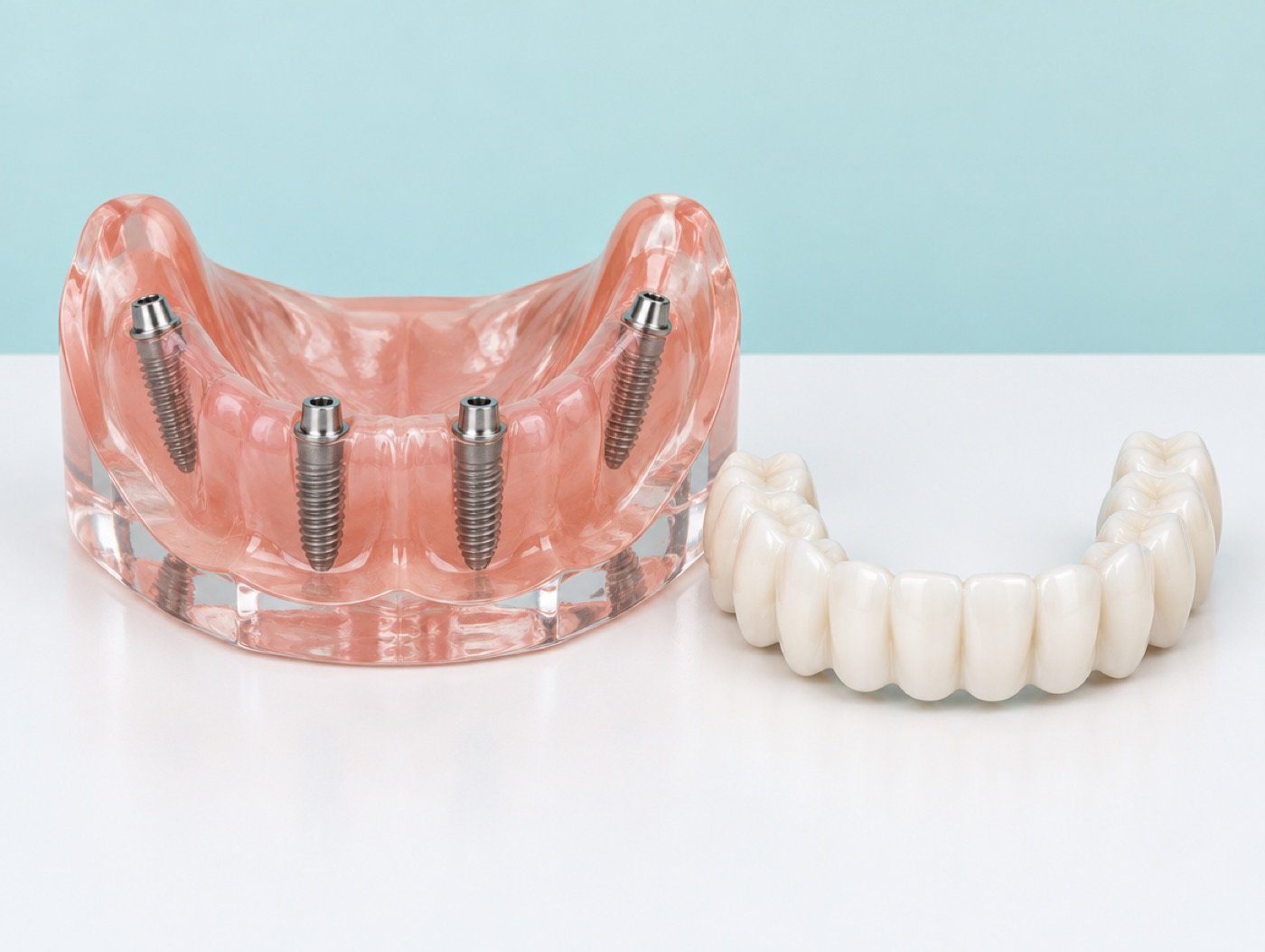
- 3D x-ray and scans; planning of the teeth and the four implant positions.
- Removal of any remaining failing teeth and placement of four implants, usually in one surgery.
- If the implants are stable enough, a fixed temporary bridge is attached, often within 24–72 hours.
- Healing for several months while the implants fuse with the bone.
- A stronger final bridge is made and fitted.
- Professional cleaning and check-ups for life.
What the long-term research shows
In 471 patients treated with the All-on-4® treatment concept in the lower jaw at one clinic in Lisbon, prosthesis survival was 98.8% and implant survival 93% over up to 18 years. 1
Single-centre study from the clinic that developed the concept; 31.6% of patients were lost to follow-up, which can make results look better than they are.
In 1,072 patients treated with the All-on-4® treatment concept in the upper jaw at the same clinic, prosthesis success was 99.2% and implant survival 94.7% over up to 13 years. Smoking was associated with implant failure. 2
Single-centre retrospective series; 20.4% of patients were lost to follow-up.
A 2026 systematic review of 55 studies found similar implant survival for four-implant and six-implant full-arch bridges, with long-term (≥5 years) pooled survival of about 98% for both. 3
Pooled data from many clinics and implant brands; not specific to one manufacturer.
A meta-analysis of 44 publications found no overall difference in failure rates between tilted and straight (axial) implants, although in studies of the upper jaw only, tilted implants failed more often. 4
These are good results, but they come mostly from experienced teams and from patients who attended their check-ups. Results in your case depend on your health, your bone, your hygiene and the team.
Would you like a dentist to assess whether this treatment suits you?
Request an assessmentWho it may suit, and who not
- People who have lost, or are about to lose, most teeth in a jaw and want fixed teeth instead of a denture.
- People with some bone loss who want to avoid major bone grafting, if the plan allows.
- Not everyone: very severe bone loss may need zygomatic implants or grafting; uncontrolled diabetes, heavy smoking or poor hygiene raise risks.
Risks and maintenance
- Bridge or screw problems (chipping, loosening) are the most common issues and are usually repairable.3
- Inflammation around implants (peri-implantitis) if cleaning and check-ups are neglected.5
- If one implant fails, the bridge may need adjustment and a new implant.
The EFP S3 clinical guideline on peri-implant diseases centres prevention on oral hygiene, regular supportive care and managing risk factors such as smoking. 5
The name: why we write "All-on-4® treatment concept"
The term "All-on-4® treatment concept" contains a registered trademark of Nobel Biocare. The owner asks that it is written as "All-on-4® treatment concept". Other clinics use generic terms such as "full arch on four implants". A clinic using the name does not guarantee it uses Nobel Biocare implants: ask which implants and parts will be used, and ask for the implant passport.6
Frequently asked questions
Is All-on-4 a type of implant?
Do I get teeth the same day?
How long does All-on-4 last?
How much does it cost?
Last updated 28 Sep 2026 · How we review
Sources
- Independent clinical studyMaló P et al. The All-on-4 treatment concept in the edentulous mandible: longitudinal study with 10–18 years of follow-up. Clin Implant Dent Relat Res 2019 — Clin Implant Dent Relat Res, 2019. Accessed 28 Sep 2026.
- Independent clinical studyMaló P et al. The All-on-4 concept for the edentulous maxilla: longitudinal study with 5–13 years of follow-up. Clin Implant Dent Relat Res 2019 — Clin Implant Dent Relat Res, 2019. Accessed 28 Sep 2026.
- Systematic reviewShao WH et al. All-on-4 and All-on-6 implant-supported fixed prostheses: systematic review and meta-analysis. Int J Oral Maxillofac Surg 2026 — Int J Oral Maxillofac Surg, 2026. Accessed 28 Sep 2026.
- Systematic reviewChrcanovic BR et al. Tilted versus axially placed dental implants: a meta-analysis. J Dent 2015 — J Dent, 2015. Accessed 28 Sep 2026.
- Consensus / guidelineHerrera D et al. Prevention and treatment of peri-implant diseases — EFP S3 level clinical practice guideline — J Clin Periodontol, 2023. Accessed 28 Sep 2026.
- Manufacturer documentationNobel Biocare — Trademarks and trademark usage guidelines — Nobel Biocare Services AG, 2026-09-28. Accessed 28 Sep 2026.
Educational information only. The choice of implant system depends on your anatomy, restorative plan, bone quality and the clinician's assessment. This website does not recommend a specific implant for you.