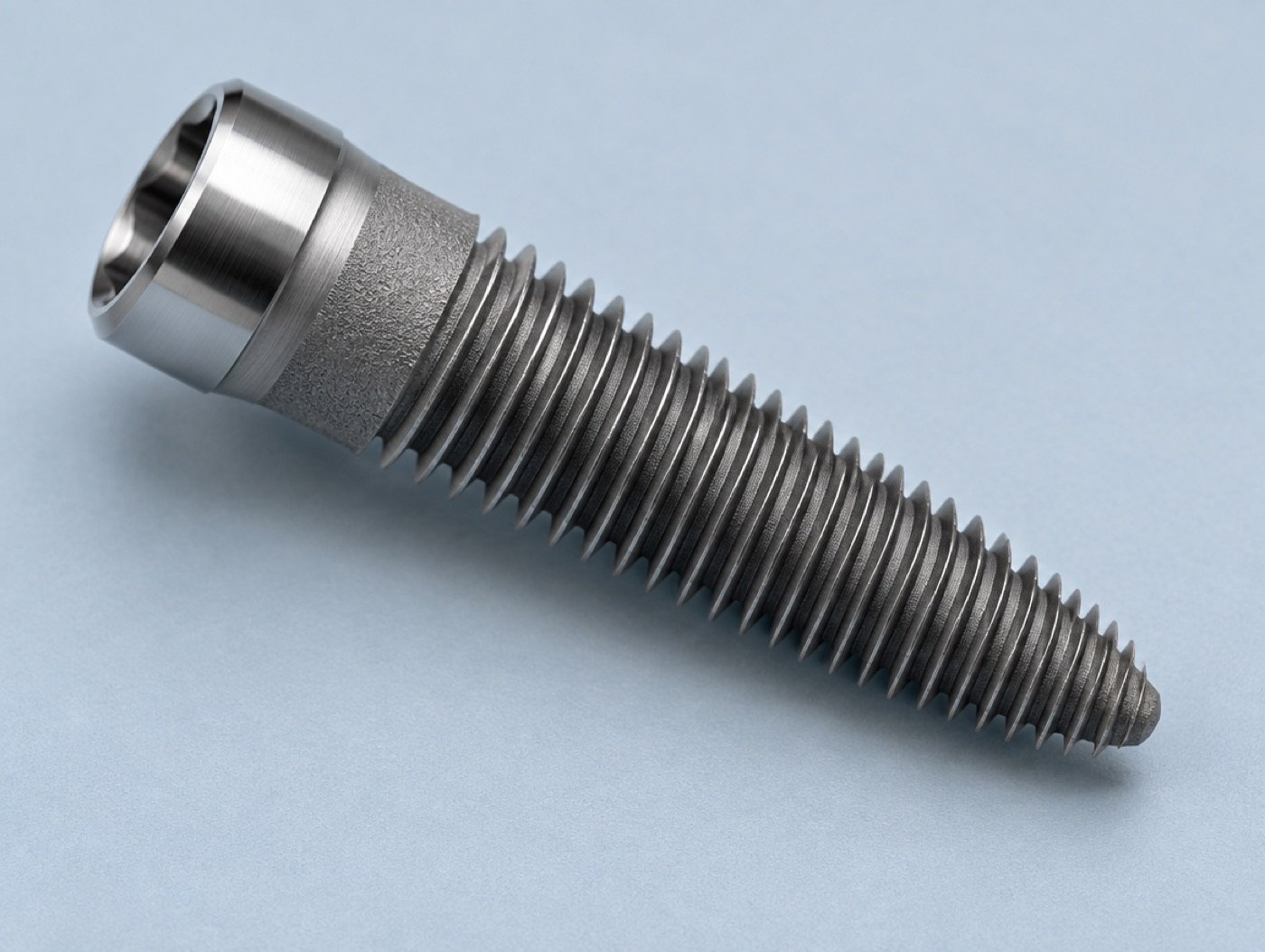
- Expanding tapered body, double-lead threads and reverse-cutting flutes at the tip.1
- Conical connection with four platforms: 3.0, NP, RP and WP.2
- US labeling covers immediate, early and delayed loading, depending on stability.1
- In a 3-year randomised trial, survival was similar to a standard tapered implant.3
What NobelActive is designed for
The FDA summary describes a tapered, expanding implant with double-lead threads and reverse-cutting flutes, available with immediate, early or delayed loading depending on the situation.1 Its design aims at stability in challenging sites, for example straight after a tooth is removed.
The ITI consensus on placement and loading protocols treats immediate loading as a clinical decision based on factors such as primary stability, bone and the restoration, not as a property of an implant brand. 4
Sizes and platforms
| Platform | Diameter (mm) | Typical use |
|---|---|---|
| 3.0 | 3.0 | Very narrow gaps; limited indications (single incisors)1 |
| NP | 3.5 | Narrow spaces2 |
| RP | 4.3, 5.0 | Most standard sites2 |
| WP | 5.5 | Wide sites such as molars2 |
Each platform takes its own abutments. That is the main difference from the NobelActive® S implant, where every width shares one NP connection.5
Would you like a dentist to assess whether this treatment suits you?
Request an assessmentWhat independent research shows
A 3-year randomised multicentre trial of immediately loaded implants found no significant difference in survival between two NobelActive® implant versions (95.7% and 96.3%) and a standard tapered NobelReplace® implant (96.6%). 3
Industry-supported multicentre trial; 3-year follow-up.
In a university cohort of 207 NobelActive® implants, overall survival was 91.5%; survival was lower in patients with both local and systemic risk factors (76.5%) than in patients without risk factors (94.8%). 6
Small retrospective study; shows that patient factors matter more than the implant name.
The second study is a reminder that your health (for example diabetes, smoking, previous gum disease) matters more for the result than the implant name.
Regulatory and recall history
NobelActive® implants have several FDA 510(k) records since 2007. In FDA's recall database we found one NobelActive recall record: Z-2207-2020, started in July 2019, because the label of one NP 3.5 × 15 mm reference could show the wrong length. It is marked "Terminated" (completed).7
| 510(k) | Decision | Device name (as filed) |
|---|---|---|
| K142260 | 11 May 2015 | NobelActive |
| K133731 | 8 May 2014 | NOBELACTIVE WIDE PLATFORM (WP) |
| K102436 | 9 Dec 2010 | NOBEL ACTIVE 3.0 |
| K083205 | 13 Feb 2009 | NOBELACTIVE 8.5 MM & 18.0 MM |
| K071370 | 3 Aug 2007 | NOBELACTIVE INTERNAL CONNECTION IMPLANT |
5 record(s) from the openFDA 510(k) database, retrieved 28 Sep 2026. A 510(k) clearance means FDA found a device substantially equivalent to one already on the market; it is not a quality ranking.
When NobelActive may not be the obvious choice
- Very dense bone, where an aggressive thread can be harder to control: a surgeon may prefer a parallel or less aggressive design such as the NobelParallel™ CC implant.
- When the clinic prefers one prosthetic connection for all sizes: the NobelActive® S implant.
- Patients who want a metal-free implant: the ceramic NobelPearl™ implant.
- Severe upper-jaw bone loss: zygomatic implants may be discussed.
Frequently asked questions
Is NobelActive a good implant?
Can I get teeth on the same day with NobelActive?
How much does a NobelActive implant cost?
Last updated 28 Sep 2026 · How we review
Sources
- Regulatory recordFDA 510(k) K142260 — NobelActive — U.S. Food and Drug Administration, 2015-05-11. Accessed 28 Sep 2026.
- Manufacturer documentationNobel Biocare — CC implants and prosthetics product overview 25.1 (95092) — Nobel Biocare Services AG, 2025. Accessed 28 Sep 2026.
- Independent clinical studyArnhart C et al. Variable-thread tapered implant designs vs a standard tapered design after immediate loading: 3-year multicentre RCT. Eur J Oral Implantol 2012 — Eur J Oral Implantol, 2012. Accessed 28 Sep 2026.
- Consensus / guidelineMorton D et al. Group 5 ITI Consensus Report: Implant placement and loading protocols — Clin Oral Implants Res, 2023. Accessed 28 Sep 2026.
- Regulatory recordFDA 510(k) K252197 — Nobel Biocare S Series Implants (510(k) summary) — U.S. Food and Drug Administration, 2026-02-18. Accessed 28 Sep 2026.
- Independent clinical studySaridakis SK et al. Tapered implant with high primary stability in patients with local and systemic risk factors: 7-year data. Int J Implant Dent 2018 — Int J Implant Dent, 2018. Accessed 28 Sep 2026.
- Regulatory recordopenFDA device recall database — records with recalling firm "Nobel Biocare" (76 records) — U.S. Food and Drug Administration (openFDA), 2026-09-28. Accessed 28 Sep 2026.
Educational information only. The choice of implant system depends on your anatomy, restorative plan, bone quality and the clinician's assessment. This website does not recommend a specific implant for you.