What "graded" means
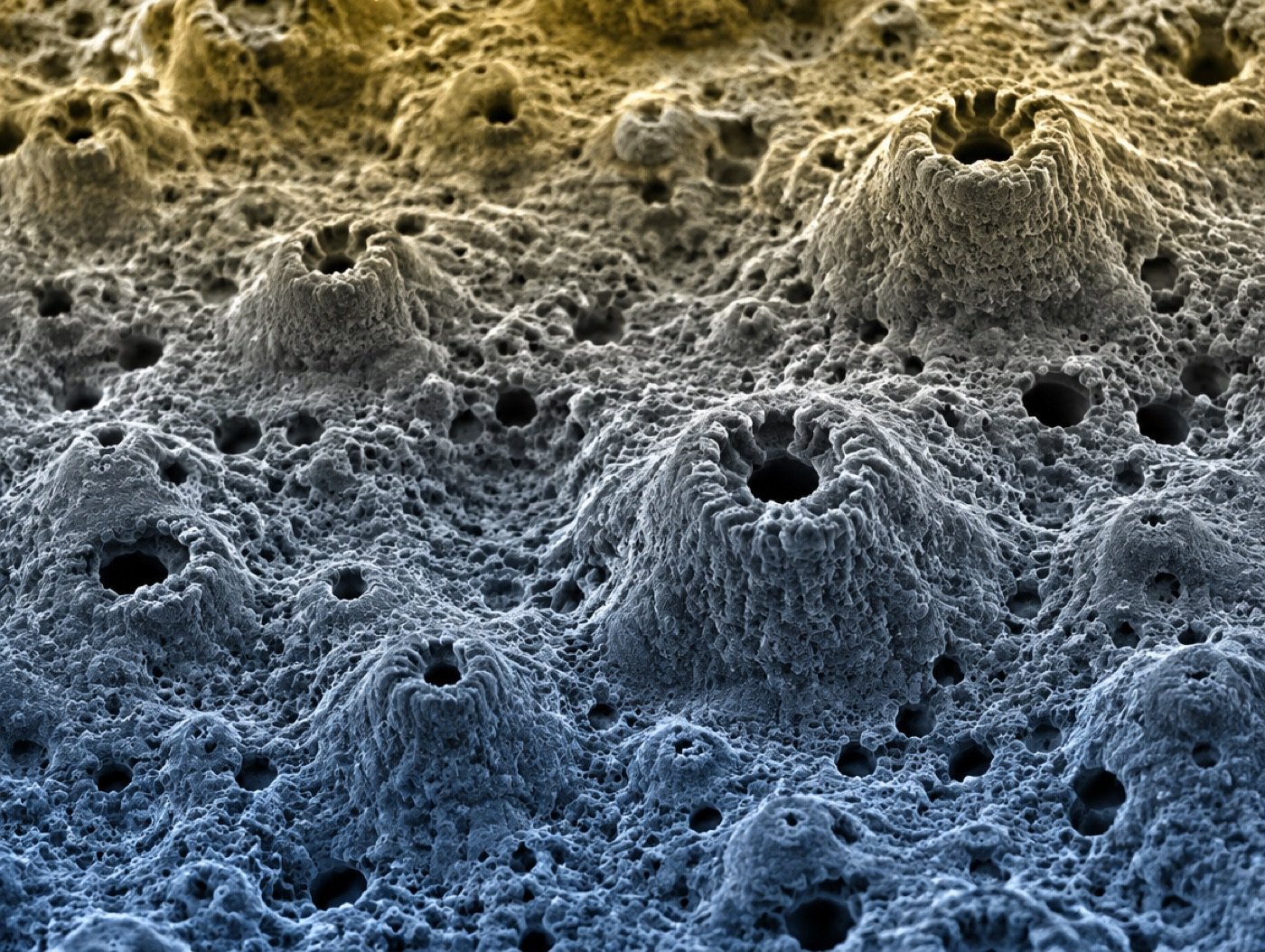
Near the gum, a smoother surface is intended to be easier to keep clean; deeper in the bone, a rougher surface gives bone more to attach to. TiUltra™ changes gradually along the implant instead of having one texture everywhere.1
What research shows so far
The FDA summary for TiUltra implants describes an anodised surface whose properties change gradually from the collar to the apex, with a salt layer applied to preserve hydrophilicity (wettability). 1
Surface properties describe the product; they do not by themselves prove better long-term results in patients.
In an animal study (minipigs) with grafted bone defects, the anodised gradient surface and two sandblasted, acid-etched comparison surfaces showed no difference in the amount and height of new bone at 2 and 8 weeks. 5
Animal study with short healing times; results cannot be transferred directly to patients.
Its predecessor TiUnite® has a large body of long-term studies. For TiUltra™ itself, most published work is laboratory, animal or short-term.
Would you like a dentist to assess whether this treatment suits you?
Request an assessmentFrequently asked questions
Is TiUltra an implant?
Is TiUltra better than TiUnite?
Last updated 28 Sep 2026 · How we review
Sources
- Regulatory recordFDA 510(k) K202344 — TiUltra Implants and Xeal Abutments (Nobel Biocare) — U.S. Food and Drug Administration, 2020-11-16. Accessed 28 Sep 2026.
- Regulatory recordFDA 510(k) K211109 — N1 TiUltra TCC Implant System (Nobel Biocare) — U.S. Food and Drug Administration, 2021-12-21. Accessed 28 Sep 2026.
- Regulatory recordFDA 510(k) K252197 — Nobel Biocare S Series Implants (510(k) summary) — U.S. Food and Drug Administration, 2026-02-18. Accessed 28 Sep 2026.
- Regulatory recordFDA 510(k) K243834 — NobelZygoma TiUltra Implant system — U.S. Food and Drug Administration, 2025-08-25. Accessed 28 Sep 2026.
- Preclinical studyShahdad S et al. Osseointegration of anodized vs sandblasted implant surfaces in a grafted dehiscence defect: minipig model. Clin Oral Implants Res 2025 — Clin Oral Implants Res, 2025. Accessed 28 Sep 2026.
Educational information only. The choice of implant system depends on your anatomy, restorative plan, bone quality and the clinician's assessment. This website does not recommend a specific implant for you.